
Tibet
Inhospitable Oblivion
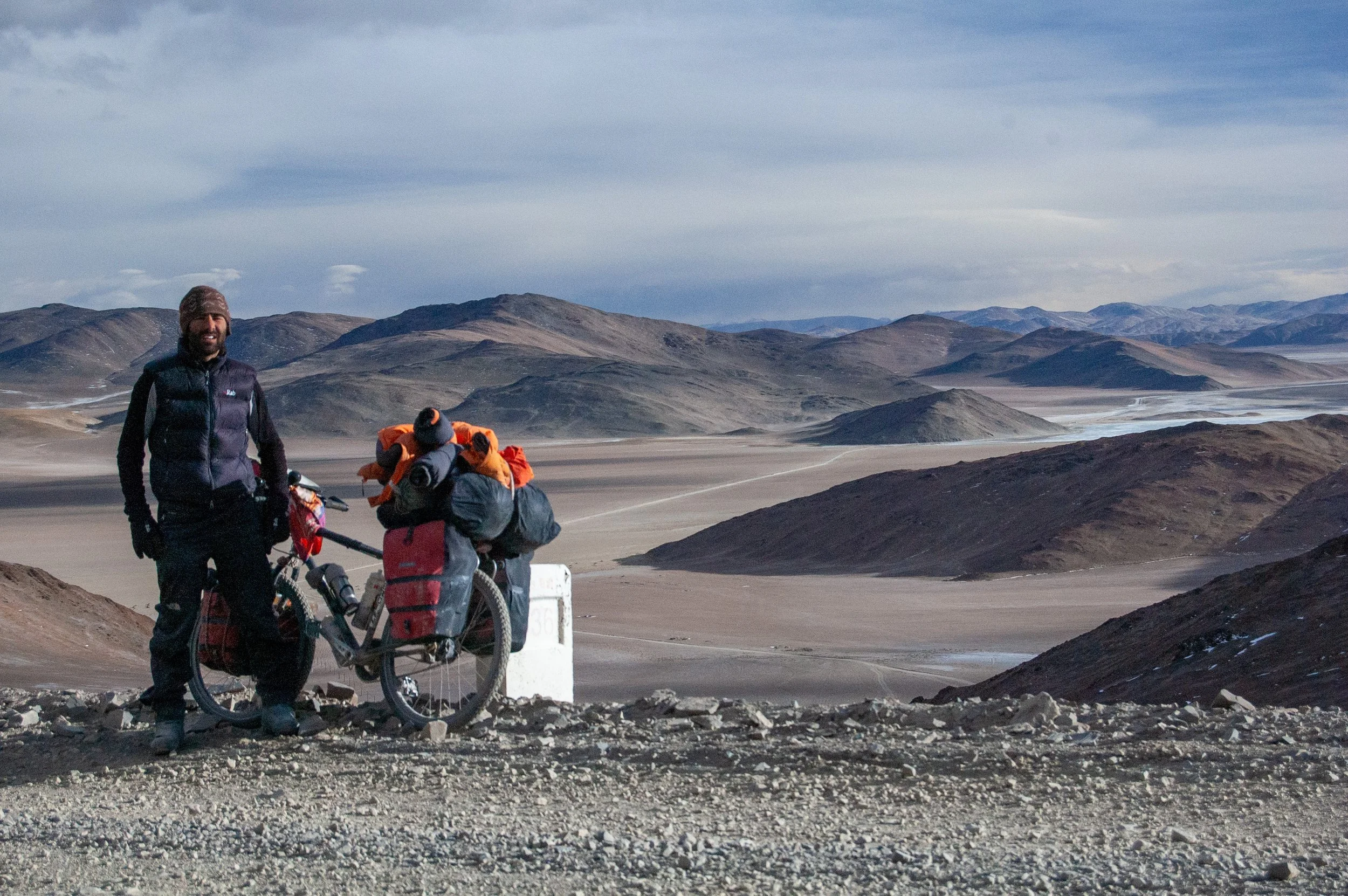
A mountainous image before mountains themselves; Dolly, my round the world bike, stood in the marble hotel foyer, piled high with winter adventure equipment. Boots, thermal clothing, arctic sleeping bags, flasks and food for a week. It was time to put sleepless nights and fears behind me, and take action. My wheels slid down the icy hotel exit ramp and the steel frame flexed under the weight, swerving through traffic jams.
Between the historic city of Kashgar and the edge of the Tibet, I traversed the Karakorum desert. Dreams of vast expanses, sand dunes and camels, were replaced with the reality of waking in a tent covered in thick snow. Snow in the desert was a new level of difficulty and the challenges were beginning. However, this empty, frozen landscape was just an introduction to a sparse, inhospitable oblivion. A spectacular high-altitude landscape, and the challenge of survival in it, lay ahead.
Chunking Down the Challenge
I turned south, joining the long road that leads to the worlds most famous mountains. Relentless climbing on switchback roads, ascending between towering peaks. With every meter gained the air got thinner and the temperature got lower. Snow got deeper, road surfaces turned to gravel and asphalt became a distant memory. Moving forward became increasingly difficult and pushing the bike was exhausting in the conditions. The target of getting to the top of the pass began to feel insurmountable, so I began chunking it down into smaller sections. Studying the map, I identified sheltered places to camp for the night and aimed for them. When even those targets felt too big, I looked ahead in the road and just headed for the next switchback; when I got there I could rest before pushing on to the next.
I crawled over the first notable pass, where I knew a viewpoint of K2 and the surrounding peaks awaited; a picturesque milestone I’d dreamt of seeing since leaving home. However, it was invisible; shrouded in the white-out of a frozen blizzard I struggled to navigate. Stopping to consider my disappointment was impossible, the only option in the mountain storm was to keep going. The red posts of road markers became the only colour in the monochrome landscape, marking the edge of a fall, hundreds of meters down to a cold rocky end. Dolly’s wheels continued, swerving along the narrow, snow-covered track.
Finally, I reached the top of the climb, five thousand meters high. I stood, literally breathless, after a week of climbing. Legs, heart and head, all ached. Finally, overcast skies were banished and valleys of pure rock emerged as a deep blue adorned the space between grey mountain peaks. I left behind the icy contours and cycled into a wonderful etching of contorted rocks, twisting formations of the earth’s core. Shadows moved quickly across valleys and bright sun defrosted the dusty trails. Onto the rooftop of the world, for hundreds of kilometres cycling above 4000m.
Survival at Altitude
Life changed in extreme altitudes and freezing temperatures. Normal daily tasks demanded more attention and effort at temperatures constantly below minus ten, always wearing four or five layers of clothing and doing everything in three layers of gloves. Finding water in an uninhabited world required walking out onto frozen rivers and lakes, smashing a hole in the surface, knowing that nobody was coming to save me if I fell in. The water I collected, acted like super glue on the threads of flasks. I sheltered behind boulders as sandstorms raged towards me from the horizon, picking up swirls of particles and throwing them at me in furious winds. Progress was so difficult and slow that, on the worst days, I could look back at the end of the day and still see where I’d camped the night before.
At night, the temperatures plummeted to minus forty degrees and I camped in the frozen shadows of mountains in the small tent I’d left home with. Clear nights on the rooftop of the world were spectacular; it truly felt like sitting on the edge of a planet, flying through space. Life was put into perspective, I was small, my troubles were insignificant. Good preparation got me through the nights and I slept well in an arctic sleeping bag, with my three-season sleeping bag inside and still wearing clothes. However, the mornings were the most difficult part; unzipping those sleeping bags and feeling the frozen air bite my skin, before changing into clothing that had frozen solid overnight. But day-by-day, I made my way across Tibet.
Heightened Self-Belief
I climbed over the Himalayas, beginning the long descent into Nepal, and life slowly returned to the world around me. The greens of leaves started to appear on the trees that lined the valleys and, descending further, red flowers on plants; the colour appeared to be so rich, I hadn’t realised the frozen world I’d passed through had been black and white for months. The air that had been so coarse began to soften and when I removed a few layers, the gentle breeze caressed my skin. I stopped at the Friendship Bridge and a fly landed on my arm; I watched curiously, my ride had been empty of life for so long. As I cycled into the first small village, I smelt the food cooking at the roadside and the shampoo of people washing behind their homes, I heard the children playing in the schools. It was incredible, the world was so alive.
I looked around and realised how far I’d come. I’d cycled from my industrial hometown of Derby, to Nepal; a world of temples, prayer flags, monkeys and incense. I thought back through the challenges I’d had to overcome on my journey to get there, the people I’d met, the places I’d seen and the lifestyle I’d created. And in that moment, for the first time, I’d proved to myself what I was capable of and I truly believed that I would cycle all the way around the world.
